
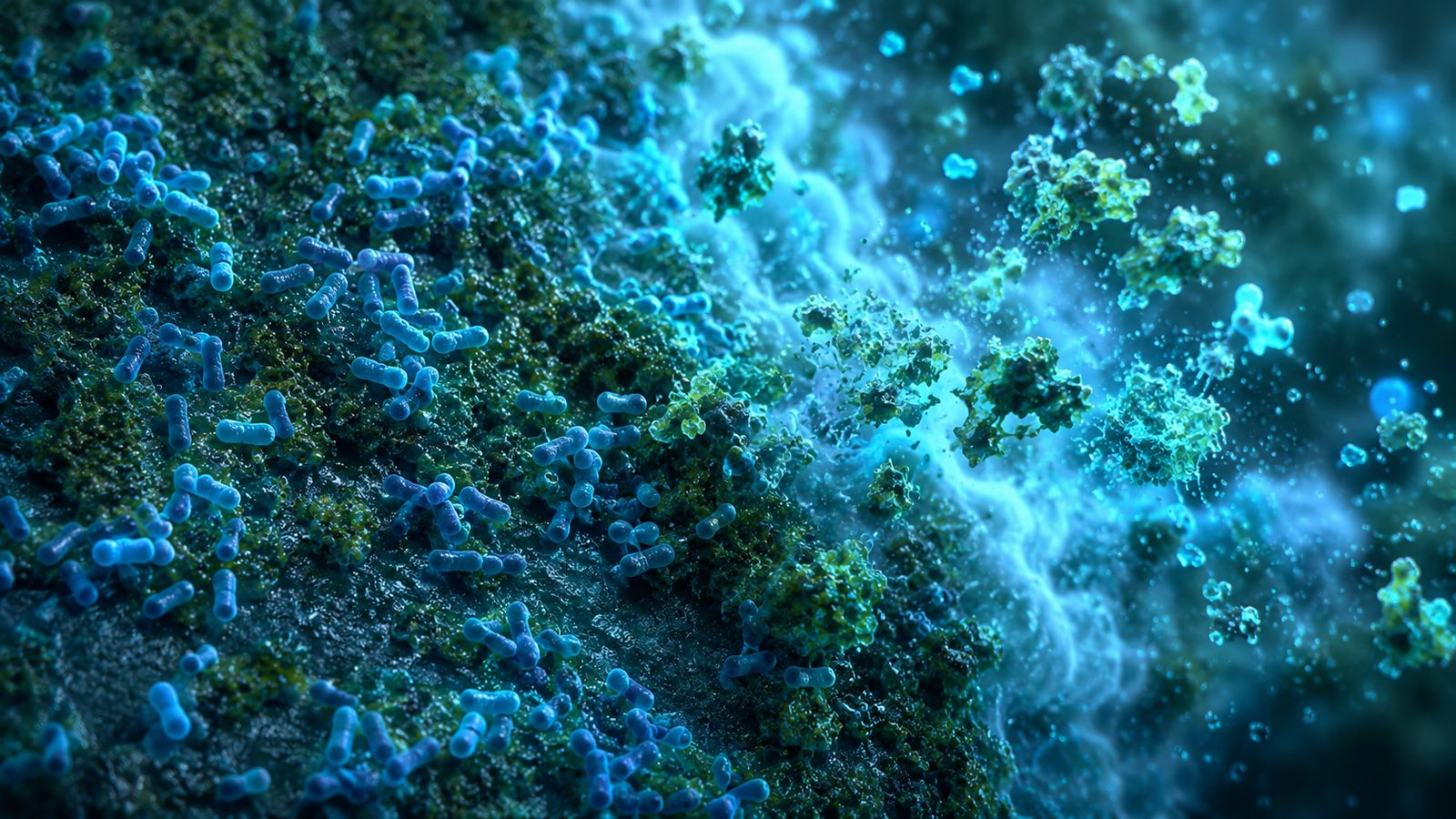
6-Log Legionella Reduction in Under 10 Seconds
Independent testing by Special Pathogen Laboratory (Pennsylvania) of Jenfitch mineral oxychloride chemistry held at a target ORP.
Jenfitch mineral oxychloride chemistry achieved a 6-log Legionella reduction in under 10 seconds in independent testing by Special Pathogen Laboratory in Pennsylvania. Dosing to hold system ORP above +700 mV also breaks down the biofilm that harbors roughly 90% of Legionella, eliminating legionellosis risk in most systems in under four hours.
Last updated 26 September 2026
The Problem
What was the Legionella problem?
Legionella thrives in warm water systems — it prefers 20–50 °C, with an optimum near 37 °C — making cooling towers and similar equipment a persistent risk. The bacteria are hard to reach because roughly 90% of Legionella lives inside biofilm (Montana State University Center for Biofilm Engineering), where it is more resistant to treatment and harbored by amoebae.
Conventional disinfection struggles to penetrate that biofilm fast enough to drive Legionella down to safe levels, leaving systems exposed to legionellosis.
The Program
How did Jenfitch control Legionella?
Jenfitch's mineral oxychloride chemistry is dosed to a target oxidation-reduction potential rather than by ppm alone. Because kill efficacy tracks ORP, holding the system above +700 mV creates a disinfection regime lethal to Legionella — and its reactive oxygen species break down the biofilm that shields the bacteria.
- Hold system ORP above +700 mV using JC 9450 / JC 9465 mineral oxychloride chemistry.
- ROS attacks the biofilm matrix where ~90% of Legionella hides, not just the free-swimming cells.
- Single-chemical, ORP-controlled program that also manages algae, scale, and corrosion.
- Kill validated independently by Special Pathogen Laboratory in Pennsylvania.
The Data
What were the results?
| Parameter | Result |
|---|---|
| Legionella reduction | 6-log |
| Contact time to achieve it | Under 10 seconds |
| ORP held | > +700 mV |
| Time to eliminate legionellosis in most systems | Under 4 hours |
| Share of Legionella living in biofilm | ~90% |
Fast enough to matter
Holding ORP above +700 mV delivered a 6-log Legionella reduction in under 10 seconds — and, by breaking down the sheltering biofilm, eliminated legionellosis in most systems in under 4 hours.
The Real Target
Why is biofilm the target, not water?
Testing tower water and finding it clean is not the same as having a clean tower. Research from the Center for Biofilm Engineering at Montana State University puts roughly 90% of Legionella inside biofilm rather than free-floating in the bulk water. A grab sample measures the 10%.
Biofilm is not a passive layer. Its extracellular polymeric substance shields the organisms inside it, and Legionella grown in biofilm is measurably more resistant to disinfection than the same organism grown in suspension. Biofilm also harbours amoebae, which Legionella parasitises — giving the bacterium a second protected reservoir inside the first.
Temperature makes a cooling tower an unusually good host. Legionella prefers 20–50 °C with an optimum near 37 °C, which is the normal operating range of tower water for much of the year.
There is a second reason to care about the biofilm even setting risk aside. On a heat-transfer surface, biofilm is roughly 300% worse than calcium-carbonate scale of the same thickness. ASHRAE data shows a fouling factor of just 0.001 can cut efficiency by about 10%, and Southern California Edison has cited electricity savings of 20% or more where fouling is properly controlled. The biofilm that hides Legionella is also the biofilm raising the power bill.
Operating Guidance
The ORP control band
The Special Pathogen Laboratory result — a 6-log reduction in under 10 seconds — is tied to a specific condition: holding ORP above +700 mV. Kill rate in this chemistry is a function of oxidation potential, not of concentration, which is why ORP rather than ppm is the number to control against.
In practice that means two different setpoints for two different jobs. Routine biofilm and MIC control in a tower runs in the 400–500 mV band. Remediation — breaking down established biofilm and the organisms inside it — needs the higher 600–800 mV range. Held there, most systems clear in under four hours.
Because the same product covers oxidation, biofilm dispersion, and algae control, the tower runs on a single ORP-controlled feed instead of a biocide, a dispersant, and an algaecide on separate schedules. That is a maintenance simplification as much as a chemical one — and unlike ozone, the chemistry leaves a residual, so protection persists between doses instead of dissipating.
Documentation
Read the full study
Related: Cooling Towers & Scrubbers research · ORP Chart
Frequently Asked Questions
About this Legionella result.
Who validated the 6-log reduction?
Special Pathogen Laboratory in Pennsylvania confirmed a 6-log Legionella reduction in under 10 seconds when the system is held above +700 mV. The testing was run on Jenfitch mineral oxychloride chemistry, the same chemistry sold as JC 9450 and JC 9465. Because the result is tied to holding a target oxidation-reduction potential, it reflects how the program is actually operated in a cooling system rather than a fixed product concentration.
Why is biofilm the key issue?
Roughly 90% of Legionella lives inside biofilm (Montana State University Center for Biofilm Engineering), where it is more resistant and harbored by amoebae. Jenfitch ROS breaks down that biofilm so the bacteria can be reached. Conventional disinfection struggles to penetrate the matrix fast enough to drive counts down to safe levels, which leaves warm-water systems exposed. Legionella favors warm water between 20 and 50 degrees Celsius, with an optimum near 37, so cooling towers remain a persistent risk.
How does ORP control the kill?
The chemistry is dosed to a target ORP rather than by ppm alone. Because kill efficacy tracks ORP, holding above +700 mV delivers a 6-log kill in under 10 seconds. Oxidation-reduction potential measures how oxidizing the water is at any moment, so it reflects the condition that actually kills the organism. Running JC 9450 or JC 9465 to that setpoint gives a single-chemical program that also manages algae, scale, and corrosion.
How quickly can a system be cleared?
By breaking down the sheltering biofilm, the program eliminates legionellosis in most systems in under 4 hours. That speed comes from attacking the biofilm matrix where roughly 90% of Legionella hides, rather than only the free-swimming cells in the bulk water. The system is held above +700 mV with JC 9450 or JC 9465 mineral oxychloride chemistry, and the kill itself takes under 10 seconds at that potential.