Mineral Oxychloride vs. Ozone

Ozone-class oxidation from a stable, pourable liquid — with a measurable ORP residual and no gas-generation train — at less than 1% of the cost of a conventional ozone system.

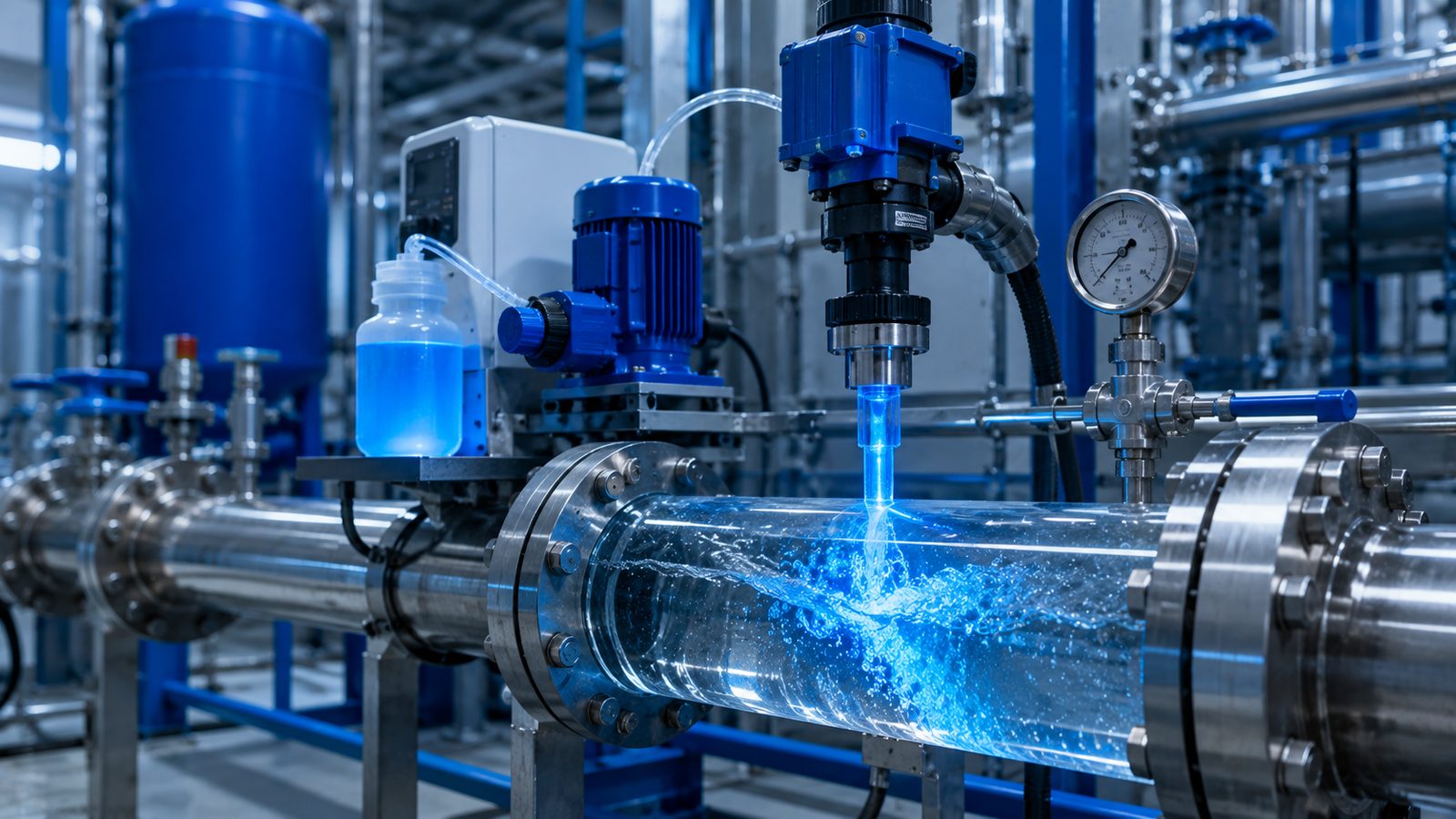
Mineral oxychloride delivers ozone-class oxidation at an effective 2.8 to 2.9 V, above ozone's 2.07 V, but ships as a stable, water-soluble liquid dosed with a metering pump and ORP controller. It leaves a measurable ORP residual where ozone dissipates, needs no generator or off-gas train, and runs at under 1% of the cost of a conventional ozone system.

Approved, certified & independently validated

UC DavisUniversity of WashingtonSpecial Pathogen LaboratoryMontana State UniversitySawtooth Ag ResearchGreenAgri SolutionsSouthern California EdisonGoleta Water District
2.8–2.9 VMineral oxychloride vs 2.07 V for ozone — near-equal, ozone-class oxidation
<1%Of the cost of a conventional ozone system for equivalent oxidation
ResidualMeasurable ORP residual — ozone dissipates and leaves none
No gasNo generator, contactor, or off-gas train to build and run

Side by Side

How does mineral oxychloride compare to ozone?

Comparison of Jenfitch mineral oxychloride (JC 9465 / JC 9450) against a conventional ozone (O3) system across key selection criteria.
CriterionMineral oxychloride (JC 9465 / 9450)Ozone (O3)
Oxidation potential (V)2.8–2.92.07
MechanismReactive oxygen species released in situ from a liquidDissolved ozone gas / hydroxyl radicals
Residual protectionMeasurable ORP residual; mildly biocidal by-productsNone — ozone dissipates quickly
Handling / safetyStable, 100% water-soluble ready-to-use liquidGenerated on demand; off-gas and O₃ exposure controls
Capital costMetering pump and ORP controllerGenerator, contactor, off-gas destruction, power supply
Operating cost<1% of a conventional ozone systemHigh — energy-intensive gas generation
By-productsMineral-oxide by-products below FDA limitsBromate potential in bromide-bearing waters
Control methodORP (mV), tied directly to kill efficacyDissolved-ozone / off-gas monitoring

Ozone-Class, Without the Gas

Why is this simpler than ozone?

Ozone is a powerful oxidant at 2.07 V and a mainstay of advanced water treatment for taste, odor, color, and micro-pollutant destruction. Its drawback is the system around it: ozone must be generated on site from oxygen or air, dissolved into water through a contactor, and its off-gas destroyed — an energy-intensive train with real capital, maintenance, and safety overhead. And once generated, ozone dissipates quickly and leaves no residual, so downstream protection has to come from a second chemical.

Mineral oxychloride delivers ozone-class oxidation — an effective potential of 2.8–2.9 V, near-equal to and even above ozone — but from a stable, pourable liquid. It is described as “ozone-class oxidation without dissolving a gas in water.” The weakly bound mineral–oxygen complex releases reactive oxygen species (including the hydroxyl radical, at 2.80 V) on contact, with no generator, contactor, or off-gas system to build and operate.

A residual ozone cannot leave

Because the reaction is effectively catalytic and the mineral-oxide by-products are mildly biocidal, mineral oxychloride leaves a measurable ORP residual that resists recontamination — something ozone, by its nature, cannot provide. This matters wherever downstream protection is needed, such as zebra and quagga mussel control, where ozone-class oxidation with a lingering residual is the advantage.

At a fraction of the cost

The practical result is cost. For equivalent oxidation, mineral oxychloride runs at less than 1% of the cost of a conventional ozone system — largely by eliminating the capital and energy of generating and dissolving a gas. It also integrates as an enhancement to existing ozone systems, improving performance while lowering demand. Dosing is verified by ORP: roughly +600 mV for a disinfection barrier, +700 mV for a 6-log kill in under 10 seconds.

Where ozone fits

Ozone remains an established, effective choice for taste and odor control, color removal, and advanced oxidation of trace organics in large municipal and bottling plants — particularly where an existing generation train is already in place and no residual is required.

Where mineral oxychloride fits

Choose mineral oxychloride when you want ozone-class oxidation with a residual, a far lower capital and operating cost, no gas-handling hazards, and a single liquid that scales from a bench study to a full plant on ORP control.

i

The takeaway

If you are drawn to ozone for its oxidizing strength but not its gas-generation system, mineral oxychloride gives you near-equal potential (2.8–2.9 V) as a pourable liquid, adds a measurable ORP residual ozone cannot, and does it at under 1% of an ozone system's cost.

Ozone is a proven, widely deployed technology and remains an excellent fit for many taste, odor, and advanced-oxidation duties — especially where a generation train already exists. Oxidation potentials are standard reference values; field performance depends on dose, contact time, water chemistry, and demand, and should be confirmed by a bench study and pilot.

Frequently Asked Questions

Mineral oxychloride and ozone.

Is mineral oxychloride as strong as ozone?

Yes, and then some. Its effective oxidation potential of 2.8–2.9 V is near-equal to and above ozone's 2.07 V, which is why we describe it as ozone-class oxidation. The difference is how that oxidation is delivered: ozone must be generated on site as a gas and dissolved into the water, while mineral oxychloride releases reactive oxygen species in situ from a stable, pourable liquid.

Does it leave a residual like ozone does not?

Correct. Ozone dissipates quickly and leaves no residual, so protection ends where the contactor ends. Mineral oxychloride leaves a measurable ORP residual and mildly biocidal mineral-oxide by-products that resist recontamination, and those by-products fall below FDA limits. Control is by oxidation-reduction potential in millivolts, tied directly to kill efficacy, so the residual can be read on a meter rather than inferred.

How much cheaper is it than an ozone system?

For equivalent oxidation, it runs at less than 1% of the cost of a conventional ozone system, chiefly by avoiding the capital and energy of generating and dissolving a gas. An ozone train needs a generator, contactor, off-gas destruction, and power supply, and the gas generation itself is energy-intensive. Mineral oxychloride needs only a metering pump and an ORP controller, so operating cost falls with it.

Do I need special equipment?

No generator, contactor, or off-gas destruction train is required. It is a stable, 100% water-soluble, ready-to-use liquid fed by a metering pump under ORP control, and it can also enhance an existing ozone system rather than replace it. Because nothing is generated on site, there is no on-demand gas generation and no off-gas or ozone-exposure controls to operate, and the ORP controller provides the dosing feedback.

Is ozone still a good choice?

Yes. Ozone is well-proven for taste, odor, color, and advanced oxidation, especially where a generation train already exists and no residual is needed. Mineral oxychloride is the alternative where those trade-offs become limiting, such as when capital and energy cost, on-site gas handling, bromate potential in bromide-bearing waters, or the lack of a lasting residual matter. The two can also work together, with the liquid enhancing an existing ozone process.

Let's talk water.

Need reliable treatment for an industrial facility, municipality, agricultural operation, or food process? We can help with quotes, safety data sheets, technical questions, and project scoping.

Contact Us