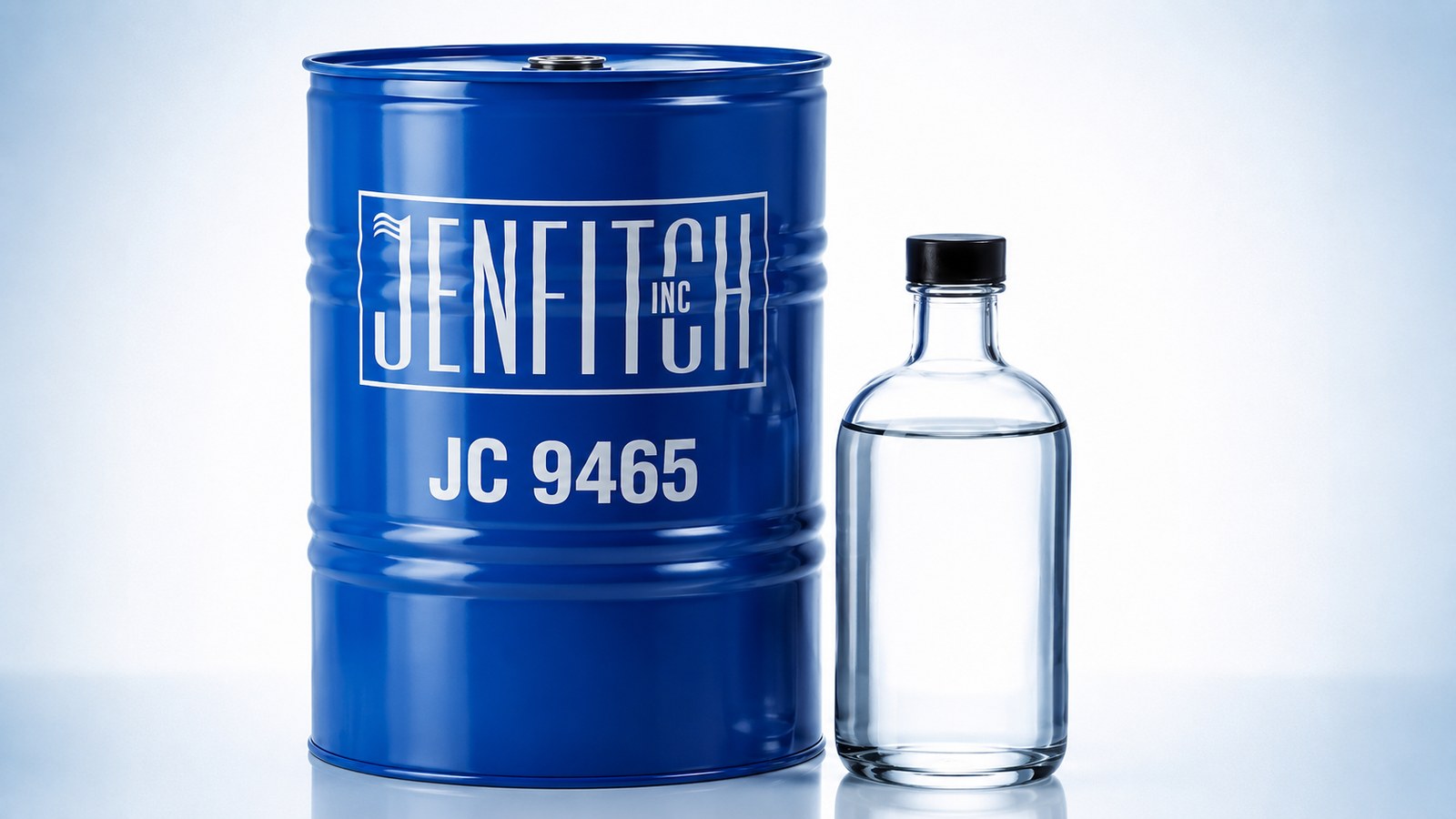
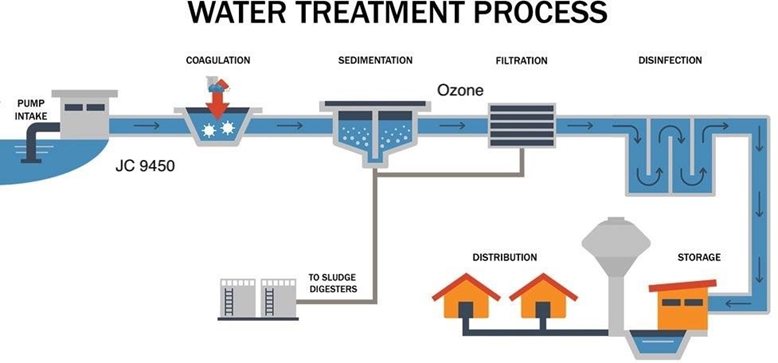
Jenfitch, Inc. of Walnut Creek, CA developed JC 9465, an advanced oxidant that uses mineral oxychloride technology to generate reactive oxygen species (ROS). The same chemistry is sold as JC 9450 for municipal and technical service; both products are certified to NSF/ANSI/CAN Standard 60 at a maximum dose of 84 mg/L.
What is ROS?
Reactive oxygen species are short-lived oxidizing radicals and molecules. Mineral oxychloride generates five: superoxide (O2−), hydroxyl radical (OH·), singlet or nascent oxygen (1O2), hydroperoxyl (HO2−), and peroxide (H2O2).
They are not selective, and that is the point. A single-target biocide gives an organism something to adapt around; a mixed radical population oxidizing cell walls, enzymes, and DNA at once does not.
What they do in a plant
- Lowering TOC (total organic carbon)
- Reducing THMs and HAA5s
- Eliminating taste and odors
- Controlling harmful algal blooms
- Improving coagulation and flocculation
- Eliminating biofilm formation
- Enhancing primary disinfectant effectiveness
How does the chemistry release oxygen?
JC 9465 is a liquid chelation of minerals with oxygen, written generically as MxOxClt. The oxygen is weakly bound, so when the complex meets organics, sulfides, a cell wall, or the polysaccharide matrix of a biofilm, it releases oxygen atoms on contact. Those released atoms are the ROS.
Sodium hypochlorite alone gives NaOCl → HOCl + OCl− + OH·. Add the mineral catalyst and the same starting material yields the mineral complexes as well, at far higher radical yield. The reaction is effectively catalytic, and the mineral-oxide by-products are mildly biocidal, so a treated system resists recontamination. Those by-products fall below FDA limits. Full chemistry is on the mineral oxychloride technology page.
Dose is controlled by ORP in millivolts, not ppm, because ORP measures the oxidizing work the water can still do. The ORP-to-CFU benchmark chart gives the relationship: +200 mV leaves roughly 300 CFU/100 mL, +300 mV about 36, +400 mV about 3, and +600 mV is disinfection.
Oxidation potential comparison
Oxidation potential decides what an oxidant can and cannot break. JC 9465 runs at 2.8–2.9 V, second only to fluorine and on par with the hydroxyl radical itself.
| Oxidant | Potential (V) |
|---|---|
| Fluorine | 3.06 |
| JC 9465 mineral oxychloride | 2.8–2.9 |
| Hydroxyl radical | 2.80 |
| Ozone | 2.07 |
| Chlorine dioxide | 1.57 |
| Chlorine | 1.36 |
| Sodium hypochlorite | 0.94 |
Fluorine is not a water-treatment reagent, so in practice mineral oxychloride tops that list. The gap that matters is the one over ozone — 2.8–2.9 V against 2.07 V, delivered as a liquid instead of a gas. Against biofilm, bacteria, viruses, and spores it runs 12–24 times more effective than chlorine.
Where does the cost come out?
Ozone-class oxidation without dissolving a gas in water. That sentence is the entire cost argument.
Capital
Equivalent oxidation from a conventional ozone system costs over a hundred times more; JC 9465 comes in under 1% of that capital. No generator, no oxygen feed, no contactor basin, no off-gas destruct. You buy a liquid instead of building a plant.
One chemical instead of a program
Most sites carry an oxidizing biocide, a non-oxidizing biocide on alternation, a dispersant, and often a separate algaecide. An ORP-controlled program does that work from one drum, on one pump, against one setpoint — fewer SKUs, fewer safety data sheets, and no guessing which product produced which result. The side-by-side against chlorine covers where the substitution holds.
Dose ratios
Feed rate is where it pays against chlorine, which needs roughly 6 mg/L per mg/L of inorganic demand.
| Demand | Dose ratio |
|---|---|
| Inorganics | Under 1.0 mg/L per mg/L (chlorine: roughly 6 mg/L) |
| Pathogens | 1.0 mg/L per 1,000–10,000 mg/L |
| Organics | 1.0–8.0 mg/L per mg/L |
Shelf life and installation
JC 9465 holds six months. Sodium hypochlorite degrades in about 30 days, faster in heat — six times the shelf life means bulk buying without chasing strength loss, and no dead stock to write off. The install is a metering pump, a storage tank, and an optional ORP controller: under 30 minutes on most sites, no civil work, no shutdown.
A metering pump, a tank, and an ORP setpoint replace a generator, a contactor, and an off-gas destruct unit.
What does it save downstream?
The chemical line item is the smallest part of the return.
- Southern California Edison has cited electricity savings above 20% on cooling systems kept free of biofilm. Biofilm fouls a heat-transfer surface about 300% worse than calcium carbonate scale.
- Feeding ROS ahead of an existing ozone train has let a utility avoid a replacement project valued at over $20 million while cutting bromate, TOC, TTHMs, and HAA5s — see enhancing ozone systems with ROS.
- Controlling biofilm removes the shelter anaerobic bacteria use to pit metal, slowing corrosion and the asset replacement behind it — see the biofilm and biodispersant program for cooling systems.
Plant-scale results
At a 10 mgd Northern California surface-water plant dosing 8–10 mg/L:
- Settled water turbidity 0.70 to 0.21 NTU; filtered water turbidity 0.06 to 0.02 NTU
- Filtered water TOC 2.2 to 1.1 mg/L, removal reaching 70% against a previous 52%
- Bromate 18 to under 1.0 µg/L, against a state and federal limit of 10
- Ozone generator operation 110%+ down to 40% of rated capacity, cutting energy 50–60% and chlorine 40%
- Taste and odor complaints 15+ down to zero
Biofilm and algae growth stopped and sludge dewatered more easily. Results depend on source water and existing treatment.
Frequently asked questions
What are reactive oxygen species in water treatment?
Short-lived oxidizing radicals and molecules — superoxide, hydroxyl radical, singlet oxygen, hydroperoxyl, and peroxide. Mineral oxychloride generates them by releasing weakly bound oxygen atoms on contact with organics, sulfides, cell walls, and biofilm. Because they hit several targets at once, organisms do not develop resistance to them.
How does JC 9465 compare with ozone?
JC 9465 runs at 2.8–2.9 V against 2.07 V for ozone. The practical difference is form: ozone is generated on site and dissolved as a gas, while JC 9465 is a ready-to-use liquid. Equivalent oxidation costs under 1% of conventional ozone capital, and unlike ozone it leaves a residual.
How much JC 9465 do I dose?
It depends on the demand. Inorganic demand takes under 1.0 mg/L per mg/L, where chlorine typically needs roughly 6 mg/L. Pathogens run about 1.0 mg/L per 1,000 to 10,000 mg/L, organics 1.0 to 8.0 mg/L per mg/L. In practice you set an ORP target and let the controller trim feed.
What ORP should I hold?
Work from the ORP-to-CFU relationship, not a ppm target. At +200 mV roughly 300 CFU/100 mL survive, at +300 mV about 36, at +400 mV about 3, and +600 mV is disinfection. Above +700 mV you get a 6-log reduction in under 10 seconds. Barriers are normally set at +650 to +750 mV.
What equipment does it take to feed?
A chemical metering pump, a storage tank, and an ORP controller if you want automatic trim. Most installations run inside 30 minutes. There is no generator, contactor, oxygen feed, or off-gas destruct to build, which keeps the exposure small enough to pilot without a capital project.
Have a water challenge like this?
Talk to Jenfitch about JC 9465, safety data sheets, or scoping a treatment program for your facility.