Jenfitch's JC 9465 is a mineral oxychloride-based oxidant that generates reactive oxygen species (ROS); it is certified to NSF/ANSI Standard 60 for drinking-water treatment up to 84 mg/L, as is JC 9450. When paired with ozone systems for surface water, it improves water quality while dramatically reducing energy and chemical demand.
Oxidation potential comparison
JC 9465's mineral oxychloride chemistry approaches the oxidation potential of the hydroxyl radical, far exceeding ozone and chlorine-based oxidants (volts):
- Hydroxyl radical: 2.80
- Mineral oxychloride (JC 9465 / JC 9450): 2.8–2.9
- Ozone: 2.07
- Permanganate: 1.67
- Hypochlorous acid: 1.49
- Chlorine gas: 1.36
- Chlorine dioxide: 1.57
Northern California study
In a 90-day trial dosing 8-10 mg/l, JC 9465 produced substantial improvements:
- Settled water turbidity: +70.0%
- Filtered water NOM: +61.4%
- Filtered water TOC: +50.0%
- Filtered water bromate: +79.8%
- TTHM's: +56.5%
- HAA5's: 100.0%+
Surface-water plant case study
Operating at a 10 mg/l dosage reduced ozone generator capacity from 110%+ to 40%, achieving a 50-60% energy reduction while maintaining a 0.20-0.30 mg/l ozone residual.
Dosing at 10 mg/l reduced ozone generator capacity from 110%+ to 40%, cutting energy use 50-60%.
What is the problem with ozone alone?
Ozone is a genuinely good oxidant and a genuinely expensive one. The generator has to make it on site, which means a power draw that scales with demand, an oxygen or air-prep train, destruct units, and a maintenance burden that does not go away. When raw-water quality degrades — an algal bloom, a storm event, a seasonal rise in natural organic matter — the only lever an operator has is to push generator capacity up. Plants regularly find themselves running above 100% of rated capacity, at which point there is no headroom left and no margin for a generator outage.
Ozone also brings a by-product problem. In a bromide-bearing source water, ozonation forms bromate, which is regulated. Pushing more ozone at a turbidity or taste-and-odour problem therefore raises a different compliance risk at the same time. And ozone at 2.07 V is well below the oxidation potential of the hydroxyl radical that does most of the useful work in an advanced oxidation process; the generator is essentially paying to produce a precursor.
What does adding ROS upstream do?
JC 9465 is a ready-to-use liquid mineral oxychloride that delivers reactive oxygen species — superoxide, hydroxyl radical, singlet oxygen, hydroperoxyl, and peroxide — at 2.8–2.9 V, second only to fluorine at 3.06 V. Because it is dosed as a liquid rather than generated, it adds oxidative capacity without adding electrical load, and it can be turned up on a bad-water day without a capital project.
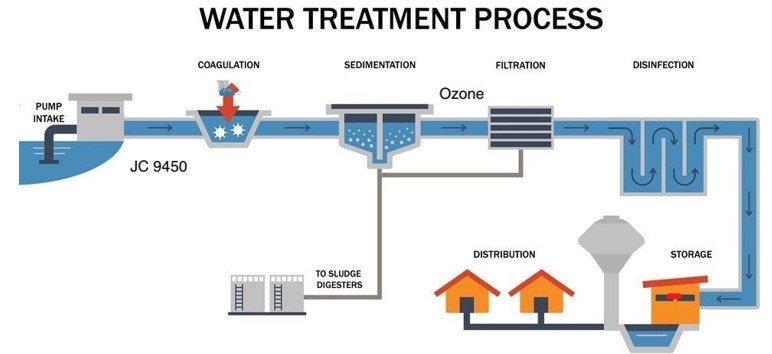
Dosed ahead of clarification, it does two jobs at once. It oxidises natural organic matter before it reaches the ozone contactor, which lowers the ozone demand the generator has to satisfy, and it destabilises colloidal material so the clarifier and filters do more of the work. Precursor removed at the front of the plant is precursor that never becomes a disinfection by-product at the back. That is why the trial results show TTHM and HAA5 improving alongside turbidity: the mechanism is precursor destruction, not by-product scavenging.
The bromate result follows from the same logic. Reducing the ozone dose required reduces bromate formation, because bromate is formed by ozone acting on bromide. The full ozone comparison sets out the capital and operating economics side by side.
How is dosing controlled and certified?
Feed is controlled to an oxidation-reduction potential setpoint rather than a fixed ppm, so the dose tracks actual water quality instead of a schedule. The ORP reference chart gives the process targets.
| Process | Target ORP |
|---|---|
| RO pre- and post-treatment | 500–650 mV |
| Drinking-water disinfection | 650–750 mV |
| Biofilm / EPS destruction | 600–800 mV |
| Sterilization | +800 mV |
The standard recommendation for iron, manganese, and biofilm removal is +650 to +750 mV, feeding ahead of the filter for optimum removal. The working pH range is 4–9. As JC 9465 and JC 9450, the same mineral oxychloride chemistry is certified to NSF/ANSI/CAN Standard 60 for drinking-water treatment at a maximum dose of 84 mg/L — which is what makes potable-side dosing possible at all. Installation is a metering pump, a storage tank, and an optional ORP controller, typically under 30 minutes.
What does this mean for an ozone upgrade?
That result — generator capacity from above 110% down to 40% while holding a 0.20–0.30 mg/L ozone residual — is significant less because of the energy saving than because of what it does to the capital plan. A plant running at the top of its generator capacity is a plant that has been told it needs a bigger generator. Recovering that much headroom by dosing a liquid changes the conversation from a capital project to an operating line item. One plant in this position avoided a $20M-plus ozone system replacement.
For utilities evaluating this, the Goleta Water District pilot covers a full potable-water evaluation, the municipal and industrial research library collects the supporting studies, and Municipal & Utilities gives the overview.
Frequently asked questions
Does JC 9465 replace an ozone system?
It does not have to. In the applications described here it is dosed alongside an existing ozone process to cut the ozone demand the generator has to satisfy, which recovers generator headroom rather than removing the system. JC 9465 is a mineral oxychloride-based oxidant that generates reactive oxygen species, and when paired with ozone systems treating surface water it improves water quality while reducing energy and chemical demand.
How much can ozone generator load be reduced?
At a Northern California surface-water plant, dosing at 10 mg/L reduced ozone generator capacity from above 110% to 40%, a 50 to 60% energy reduction, while maintaining a 0.20 to 0.30 mg/L ozone residual. Cutting the oxidant demand the generator has to satisfy is what frees that capacity, and it recovers headroom for periods when raw-water quality degrades. Results on any given system depend on the raw water and the existing process.
Why do disinfection by-products go down?
Because the mechanism is precursor destruction. Oxidising natural organic matter ahead of the contactor removes the material that would otherwise form TTHMs and HAA5. Bromate falls for a related reason: less ozone applied to a bromide-bearing water means less bromate formed.
Is it approved for drinking water?
As JC 9465 and JC 9450, the same mineral oxychloride chemistry is certified to NSF/ANSI/CAN Standard 60 for drinking-water treatment at a maximum dose of 84 mg/L. JC 9450 and JC 9465 are the same chemistry on different registration paths, so the certification is what makes full-scale application at a public water treatment plant possible. Confirm the certified product code and dose limit for your own application before use.
Where in the process should it be dosed?
Ahead of clarification for organic-matter and turbidity work, and in front of the filter for optimum iron, manganese, and biofilm removal, at an ORP of plus 650 to plus 750 mV. Those are the two points in a surface-water train where the oxidant does the most work, since clarifier-stage dosing targets organics and turbidity while filter-stage dosing targets what carries through. Site conditions determine the final injection points.
Have a water challenge like this?
Talk to Jenfitch about JC 9465, safety data sheets, or scoping a treatment program for your facility.