Jenfitch's EPA-registered product JC 9465 is an algaecide and biocide that can help improve water quality in countless applications. By eliminating algae and biofilm, it addresses two of the most persistent challenges in water treatment.
What is the ORP standard for safe water?
The World Health Organization advises that for water quality to be safe from all microorganisms, it must have an ORP above +700mV. Oxidation-reduction potential is a direct measure of a solution's disinfecting power, and reaching this threshold is the benchmark for microbiologically safe water.
How fast does it disinfect?
At an ORP above +700mV, JC 9465 achieves a 6-log removal in only 10 seconds. By comparison, chlorine requires over 30 minutes to achieve a 4-log removal.
JC 9465 achieves a 6-log removal in only 10 seconds, compared to chlorine's over 30 minutes to achieve a 4-log removal.
Case studies
California water plant
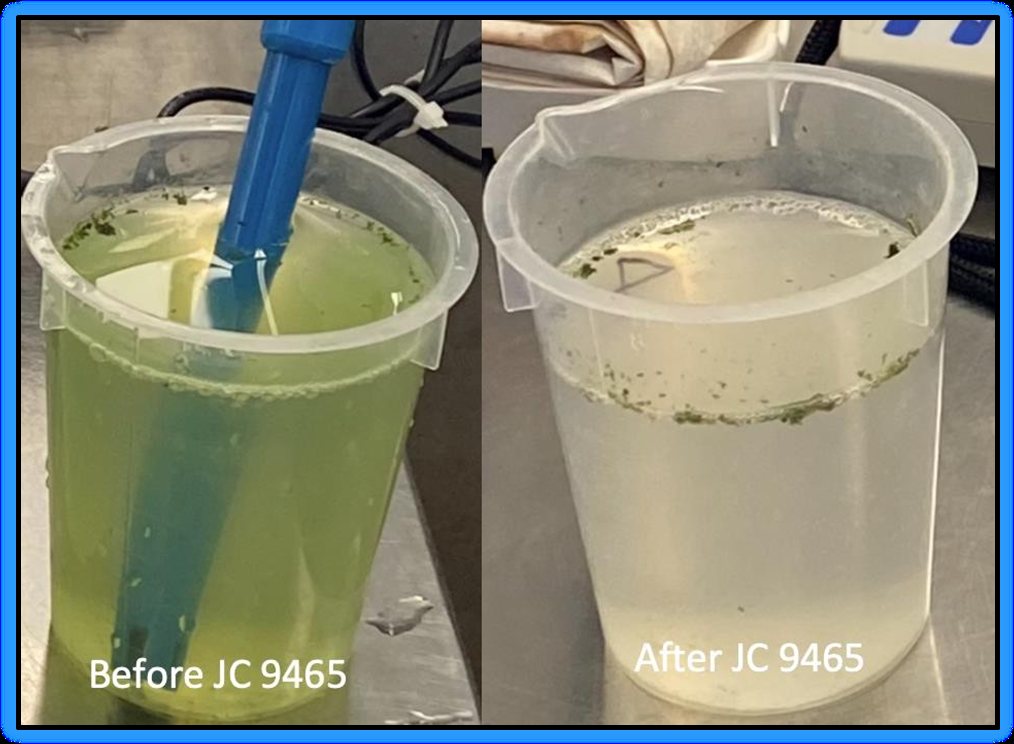
An influent sample at a California water plant was treated at a 10 ppm dosage, demonstrating JC 9465's effectiveness on real-world source water.
Northern California potable water plant
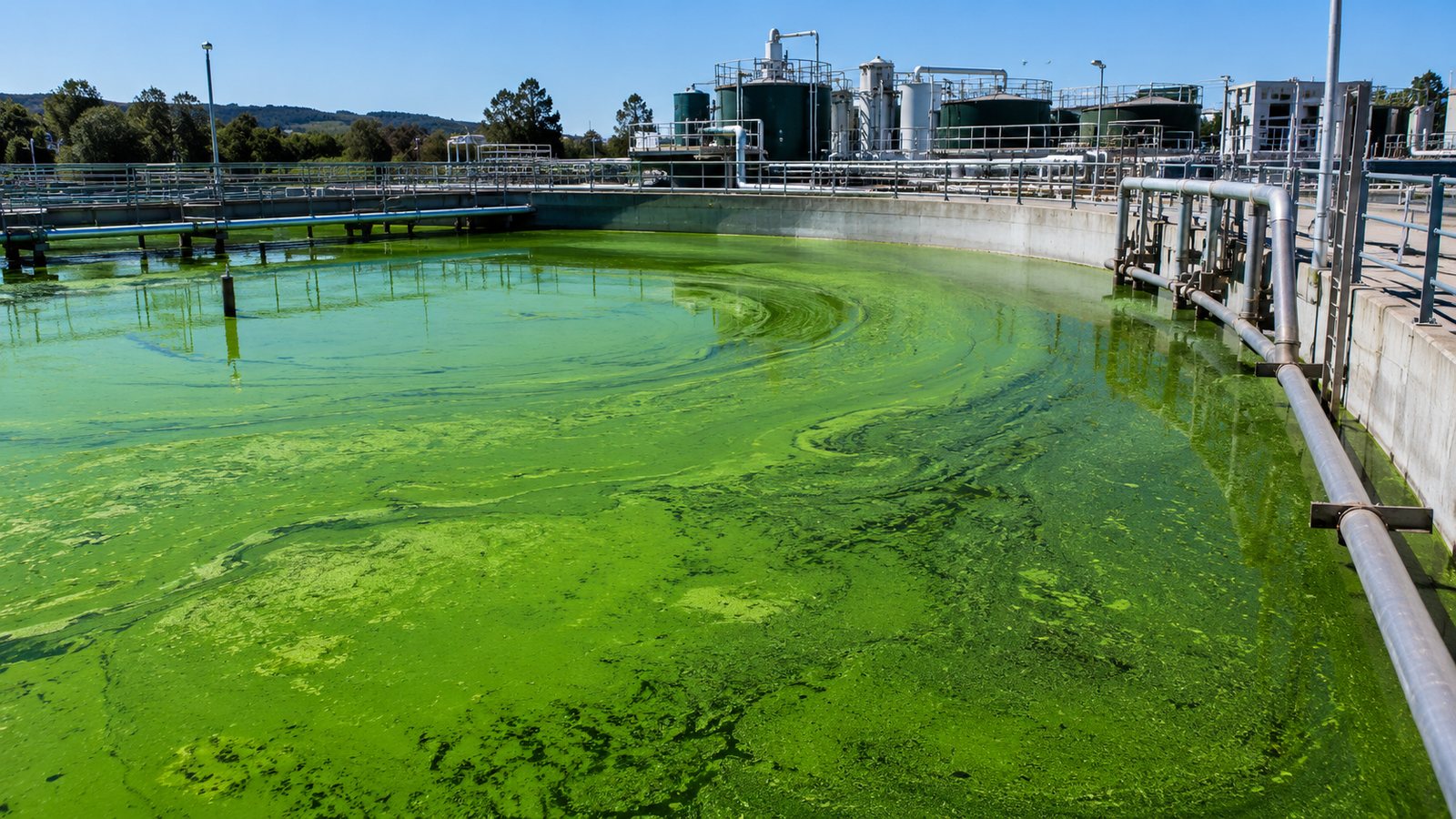
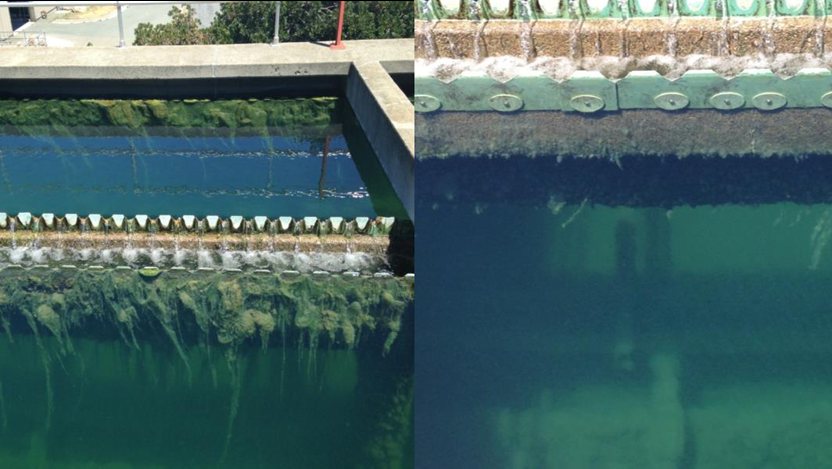
At a Northern California potable water treatment plant, treatment with JC 9465 delivered a range of measurable benefits:
- Improved filtered water turbidity
- Lower chlorine consumption
- Reduced THM formation
- Longer filter run times
- Lower treatment costs
Why it matters
By combining a high oxidation potential with rapid kill times, JC 9465 gives operators a way to control algae and biofilm while reducing chemical use and byproduct formation, improving both water quality and operating economics.
Why are algae and biofilm one problem?
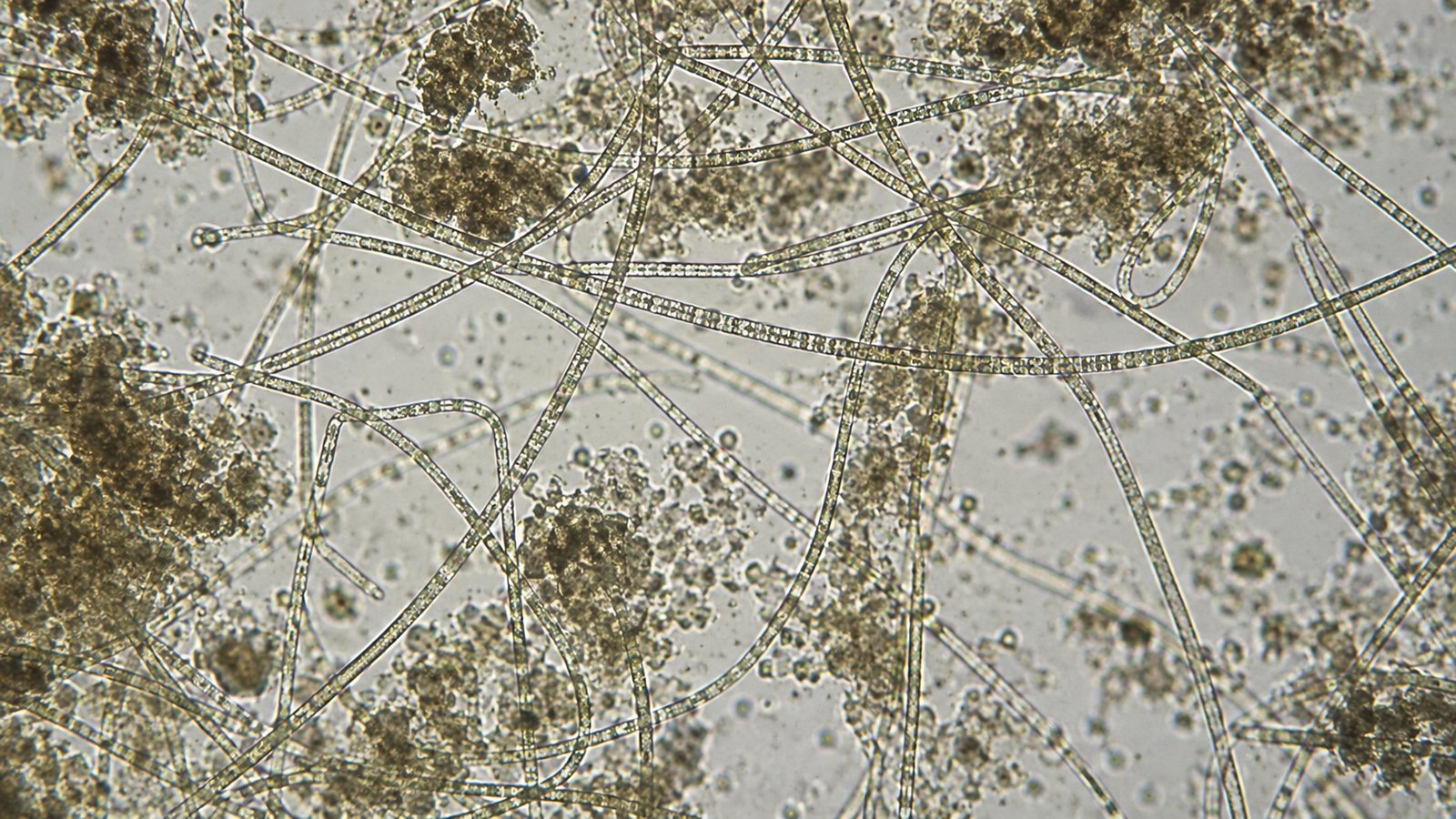
Operators tend to treat algae and biofilm as separate line items on a maintenance schedule. Chemically they are the same fight. Both are communities of microorganisms living inside a self-produced shell of extracellular polymeric substance — EPS — a hydrated matrix of polysaccharides, proteins and DNA that the colony secretes to hold itself onto a surface. That matrix is the reason conventional treatment disappoints. A free-chlorine residual that reads perfectly well in the bulk water may never reach the organisms living two hundred microns down inside the film, because the chlorine is consumed oxidising the outer layer of EPS before it can penetrate.
This is why algae blooms recur within days of a shock dose, and why a cooling tower that tests clean at the sample port still fouls its fill. Kill the planktonic cells floating in the water and the sessile population anchored to the wall simply reseeds it. Any product that only addresses free-floating organisms is treating the symptom.
JC 9465 attacks the matrix first. Its mineral oxychloride chemistry releases a family of reactive oxygen species — hydroxyl radical, superoxide, singlet oxygen, hydroperoxyl and peroxide — that cleave the polysaccharide backbone of the EPS, collapse the film, and then oxidise the exposed cells. Because the by-products are mildly biocidal mineral oxides, the treated surface resists recolonisation rather than presenting a clean substrate for the next bloom.
What makes the chemistry so fast?
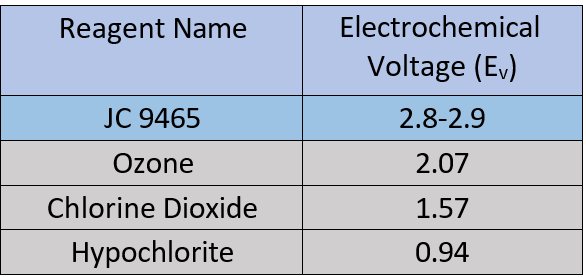
Oxidation potential, measured in volts, describes how strongly a substance pulls electrons away from whatever it contacts. It is the single best predictor of how fast an oxidant will disable a microorganism.
| Oxidant | Oxidation potential (V) |
|---|---|
| Fluorine | 3.06 |
| JC 9465 / JC 9450 mineral oxychloride | 2.8–2.9 |
| Hydroxyl radical | 2.80 |
| Ozone | 2.07 |
| Permanganate | 1.67 |
| Chlorine dioxide | 1.57 |
| Chlorine gas | 1.36 |
| Sodium hypochlorite | 0.94 |
JC 9465 sits second only to fluorine, and roughly three times the potential of the sodium hypochlorite most plants run today. That gap is what converts a thirty-minute contact time into a ten-second one. Against biofilm, bacteria, viruses and spores, the practical result is chemistry that is 12 to 24 times more effective than chlorine at equivalent measured residual. A fuller side-by-side is set out in our mineral oxychloride versus chlorine comparison.
Dosing and ORP control
The most important operational difference is that JC 9465 is dosed to an ORP setpoint, not to a ppm target. Oxidation-reduction potential is measured directly in the water with a millivolt probe, and unlike a chlorine residual it reflects the actual oxidising power available at that moment, at that pH, at that temperature. Free chlorine at 1.0 mg/L behaves very differently at pH 7.0 than at pH 8.5; ORP captures that difference where a ppm reading hides it. Our ORP reference chart maps millivolt readings to surviving colony counts.
| Objective | Target ORP |
|---|---|
| Wastewater odour and sulfide control | 200–400 mV |
| Cooling tower biofilm and MIC control | 400–500 mV |
| RO pre- and post-treatment | 500–650 mV |
| Biofilm and EPS destruction | 600–800 mV |
| Drinking-water disinfection | 650–750 mV |
| In-field and post-harvest disinfection | 650–750 mV |
| Sterilisation | +800 mV |
As rules of thumb, inorganic demand is met at under 1.0 mg/L of product per 1.0 mg/L of contaminant, pathogens at 1.0 mg/L per 1,000–10,000 mg/L, and organics at 1.0 to 8.0 mg/L per 1.0 mg/L. The chemistry is effective across a pH range of roughly 4 to 9, which removes the pH-chasing that dominates hypochlorite programs. A typical installation is a metering pump, a storage tank and an optional ORP controller, and goes in inside half an hour.
Where is it applied?
Algae and biofilm control with JC 9465 is running today in cooling towers and heat exchangers, where biofilm insulates the transfer surface far more aggressively than mineral scale; in municipal surface-water plants, where algal organics drive disinfection by-product formation; in irrigation reservoirs and canals; and in post-harvest wash and hydro-cooler water, where the same oxidant serves as both algaecide and pathogen barrier. Detailed write-ups sit in our biofilm removal article and the Legionella case study.
Frequently asked questions
Is JC 9465 EPA registered as an algaecide?
Yes. JC 9465 is registered with the US EPA under FIFRA as a biocide and algaecide, and is certified under the USDA National Organic Program (7 CFR Part 205). The same mineral oxychloride chemistry is certified to NSF/ANSI Standard 60 for drinking water as both JC 9465 and JC 9450, at a maximum dose of 84 mg/L.
How quickly does it work on algae?
At an ORP above +700 mV, JC 9465 achieves a 6-log reduction in under 10 seconds. Chlorine typically requires more than 30 minutes to reach a 4-log reduction under comparable conditions. That +700 mV threshold is the level the World Health Organization advises for water to be safe from all microorganisms, and oxidation-reduction potential is a direct measure of a solution's disinfecting power, so the speed follows from holding that setpoint.
Do I dose by ppm or by ORP?
By ORP. Set a millivolt target for the objective — 400 to 500 mV for cooling tower biofilm, 650 to 750 mV for disinfection — and let the controller feed to that setpoint. ORP reflects real oxidising power at the water's actual pH and temperature; a ppm reading does not.
Will it damage my system or leave a harmful residue?
No. The reaction is effectively catalytic and the by-products are mineral oxides that are themselves mildly biocidal and fall below FDA limits. The product is a 100% water-soluble ready-to-use liquid, non-flammable and non-combustible. Because it is metered into the water as a dilute liquid rather than applied as a concentrated slug, it travels wherever the water travels, and what it leaves behind is that same mineral oxide chemistry rather than an accumulating deposit.
How long does the product keep in storage?
Roughly six months, compared with about 30 days for sodium hypochlorite. That is about six times the usable shelf life, which matters for sites that order in drums or totes and draw down slowly. Hypochlorite loses strength as it sits, so a container bought at one concentration can be feeding a weaker solution by the time it is drawn down, while a longer stable window keeps the delivered dose closer to the label.
Have a water challenge like this?
Talk to Jenfitch about JC 9465, safety data sheets, or scoping a treatment program for your facility.